Living Lab: bringing permaculture to everyone, with the school garden as the way in
Session details
| Session type | Presentation |
| Permaculture flower | Education & Culture |
| Duration | 30 Minutes |
While talking about the ecological crisis, being anxious about the future, fearing restrictions, bans, reduced consumption and other sacrifices that are on the way, people still hire interior designers to make their homes more beautiful, while hardly anyone thinks of hiring a permaculture designer to make the land around their home work for them — securing food and water, building healthy soil, supporting biodiversity and creating an overall healthier, more fulfilling environment to live in, which is at the same time the most beneficial thing we can do for the environment.
Why does a design approach built around practical ways of bringing human and ecological well-being together remain so far from the wider public in times when it’s desperately needed?
People are not to blame. They simply don’t know about permaculture.
Maybe we should think about the ways we can reach people, expand our community and get scientists to do more research that would give us greater credibility on a global scale.
And here is one idea...
The school garden as the way in
School gardens are spreading. There is interest, and often a budget. What is usually missing is an idea. A few enthusiastic parents plant with the children once a week, the children water from time to time, and the garden becomes a pleasant addition to the school grounds. But usually, that is where it ends. There is no coherent concept, no structured educational programme and no clear connection between the garden and what children are learning in the classroom.
This is not a lack of interest. It is a lack of accessible, ready-to-use educational resources that can turn a school garden into a meaningful learning environment.
This is the gap Living Lab aims to fill.
Living Lab: the kit
Living Lab is a free educational kit designed for schools and students aged 10–14. It combines a student workbook containing ten practical experiments with a companion book for teachers and curious students.
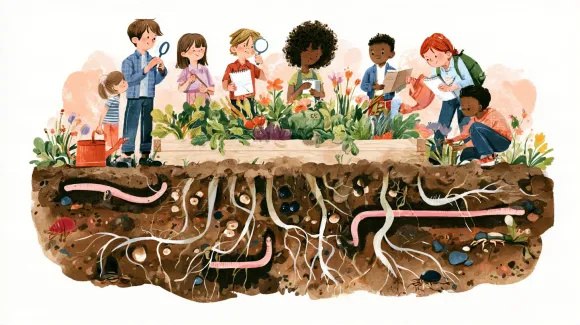
The experiments use the school garden as a living classroom. Through observation, investigation and hands-on activities, students explore soil, water, plants, food production and the relationships between living organisms. At the same time, they practise the scientific method — something they are already introduced to in their school curriculum — by asking questions, forming hypotheses, conducting experiments, recording observations and drawing conclusions.
They find out what a no-dig bed does to the soil beneath it, measure how much water a layer of mulch saves, dig up bean roots to find the bacteria that pull nitrogen out of the air and much more. Along the way, they meet the experiments that started it all: the 17th-century doctor who grew a willow in a pot to find out what a tree is made of, the chemist who used a sprig of mint to bring back air that a candle had used up, the 23-year-old PhD student who isolated streptomycin, the first antibiotic effective against tuberculosis, from the soil bacterium Streptomyces griseus, and more.
What makes it work: fun facts, all of them proven. Each experiment opens with a question that hooks students and a handful of surprising facts they piece together like a puzzle. A pinch of healthy soil holds more living beings than there are people on Earth. Most of the antibiotics we take were made from soil microbes. The earthworms in a single hectare of field move more than 25 tonnes of soil a year, the weight of four elephants... The same rigour applies to the practices at the heart of permaculture: covering the soil, not digging, composting and mixing plants are presented through the studies that measured them. In the English city of Leicester, for example, the soil of allotments, where almost every gardener made compost, held 32% more carbon than the intensive farm fields around them. Learning feels like play, but nothing in the kit rests on belief or slogans: every claim, in the workbook and in the companion book, is backed by a link to the scientific study or official data it comes from.
A companion book for teachers and curious students, covering the history of growing food, how our vegetables were bred and travelled around the world, what growing your own food means for health and the environment, and finally, permaculture as a design system for creating a small paradise of your own which regenerates life and benefits the environment.
The aim is to offer schools something they can use directly: a complete, engaging and scientifically informed educational resource that connects classroom learning with the living world outside.
This is not a PDC for children. It is the step before. It sparks curiosity about permaculture and, at the same time, shows children that science is not something distant, done by strangers in a lab. Put the two together in enough schools, and something bigger becomes possible.
The network
The kit is being sent to schools across Spain. We do not go through institutions, but through individuals: one teacher, one school garden at a time.
The next step is a network of schools running the same experiments using standardised methodology and the same rigorous methods including shared protocols for recording observations and results and checking each other’s results. One school garden proves little. Hundreds of them, with children conducting peer reviews and confirming each other’s findings, could initiate serious research.
Collaboration with researchers who can help analyse and validate the findings would be a great addition. In this way, school gardens could contribute to a growing body of comparable data and potentially generate research questions worth investigating on a larger scale.
This could create opportunities for collaboration between schools, educators, permaculture practitioners and researchers. It could also provide a foundation for gathering comparable observations from different environments and exploring questions that no single school could investigate on its own.
Students who stay connected beyond school could become “alternative global nation”: people who share an ethic, wherever they live — a growing network of young people learning to understand, investigate and care for the living world around them.
I have previously developed Perpetuum Hortus, another free educational resource designed as a small, closed-loop ecosystem for kindergarten children aged 3–5. It requires minimal maintenance and gives children the opportunity to discover, through hands-on experience, how plants, soil, water and compost are interconnected.
The system includes rainwater harvesting, efficient watering solutions such as wicking beds, buried clay pots and soaker hoses, and compost production using leaves collected from the school grounds mixed with organic kitchen scraps brought from home. It also includes a worm farm where children can observe humus production.
Inspired by a British survey of 27,500 children, which found that one in ten secondary school pupils believed tomatoes grow underground, I added a card game to the kit in which children match edible plants with their fruits. It is also available as a free online game.
And, of course, everything in the kit leads back to permaculture. The garden itself is a small example of permaculture design: children experience it every day, and teachers see how good design achieves maximum impact with minimal intervention.
I am presenting Living Lab at EuPC because I believe its next stage depends on building connections beyond the usual permaculture circles.
I would like to connect with teachers, schools and educational organisations, as well as permaculture practitioners, researchers, science communicators, people working in media and marketing, and anyone with experience in developing or distributing educational resources.
What you’ll take away
The complete Living Lab kit in English, free.
Perpetuum Hortus, a free garden kit for early-years schools.
An invitation to bring Living Lab to a school near you and join the network.
People don’t have to be a plague on the planet. We can be the best thing that ever happened to it, and children are ready to prove it.
Teacher
This session is held by Marko Simic
I’m a permaculture designer based in Andalusia, Spain, where I design homesteads, syntropic agroforestry gardens and educational gardens: places that produce food, save water and teach.